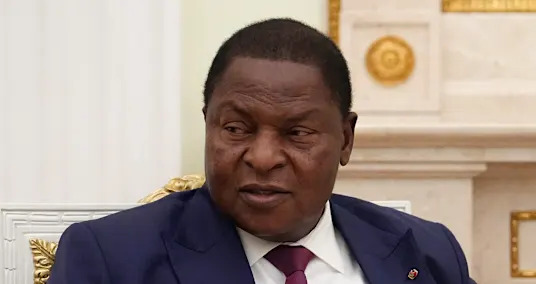
BANGUI, Central African Republic (AP) — The president of the Central African Republic, Faustin-Archange Touadéra, was sworn in for a third term on Monday three months after a disputed general election.
Touadéra will be serving a new seven-year term. He was declared the winner of the vote in December, which was boycotted by the coalition opposition party following a 2023 constitutional referendum that removed term limits and increased the presidential term from five to seven years.
“We aspire to build a sovereign economy and ensure transparent management of our natural resources,” Touadéra said at the swearing-in ceremony in Bangui, attended by the presidents of Congo-Brazzaville and Comoros.
Opposition parties and civil society rejected the results of the election, which the Constitutional Council said that Touadéra won with 77.9% of the vote.
"You have to be a fool to believe that,” said Frédéric Godoba, a civil society activist.
Conflict has broken out in the country since 2013 after mostly Muslim rebels seized power and forced then President François Bozizé to quit. The conflict was de-escalated by a 2019 peace deal between the government and 14 armed groups. Six of the 14 groups later withdrew from the agreement.
The Central African Republic is one of the countries where Wagner, a Russian mercenary group, was first active in Africa.
latest_posts


 Sexual violence part of 'everyday life' in parts of Sudan, charity says
- Protest inspired by 'Gen Z' movement draws few young people in Mexico and many government critics
- What to know about King Charles III's cancer treatment and his message to the public
- Bronze Age "City of Seven Ravines" unearthed in central Asia after 3,500 years
- Find the Mysteries of Effective Objective Setting: Transforming Dreams into Feasible Targets
- The Starbucks for Life game is back, along with your chance to win a 'Bearista' cold cup. Here's how to get your paws on one.
- How to watch 2026 Golden Globe winners like 'One Battle After Another,' 'Adolescence' and 'The Pitt'
- Winter storms blanket the East, while the U.S. West is wondering: Where’s the snow?
- Understanding climate change in America: Skepticism, dogmatism and personal experience